Ultione / Journal
Compressed Sofa Guides
Choosing a Full-Size Compressed Sofa for a Family Playroom
Make room for the adult who reads, helps and stays awhile—not just the toys. A full-size sofa should support family time without swallowing the play floor.
The short answer
What you need to know
Choose a full-size compressed sofa for a family playroom when adults need a real reading and conversation seat beside children's floor activities. ULTIONE's THE L measures 92.5 × 61 inches with a 16-inch seat height and 25.6-inch seat depth. Check the adult's comfort, the chaise footprint, open storage and the corduroy-care routine. It serves family sitting and lounging, rather than the fort-building job of a foam play couch.
- THE L footprint
- 92.5 × 61 in
- Seat dimensions
- 16 in high / 25.6 in deep
- Primary use
- Full-size adult-and-family seating
- Floor-space example
- 144 − 61 − 18 = 65 in
A full-size compressed sofa belongs in a family playroom when someone needs a proper seat for reading aloud, helping with a puzzle or spending time with children. It should make those moments more comfortable while leaving enough floor for the activities that brought the room into use.
That is a different purchase from a foam play couch designed for building forts. ULTIONE’s compressed sofas are full-size seats with upholstered modules. Judge them as places to sit and lounge, not as climbing equipment or interchangeable toy blocks.
In a US or Canadian home where the playroom also becomes a family hangout, begin with two plans: where the adult sits and where the children play. Then add storage in its open position and a cleaning routine you can actually keep up with.
Start with the adult who uses the room
Children may spend much of their time on the floor. The adult supervising, reading or helping needs a seat too. Choosing only from a child’s perspective can leave that person perched on a tiny chair or sitting on the edge of a sofa that does not suit them.
THE L compressed sofa has a 16-inch seat height and 25.6-inch seat depth, approximately 40.6 and 65 cm. Those are low, deep lounge dimensions. Compare them with the seat the regular adult user already finds comfortable.
 THE L compressed sofa
For reading aloud, try sitting upright with a book and a child beside you. Notice whether the back cushion meets you where you need it and whether you can see the page without leaning around someone. For conversation or a movie, try the relaxed position as well. The same sofa may serve both, but the cushion arrangement can differ.
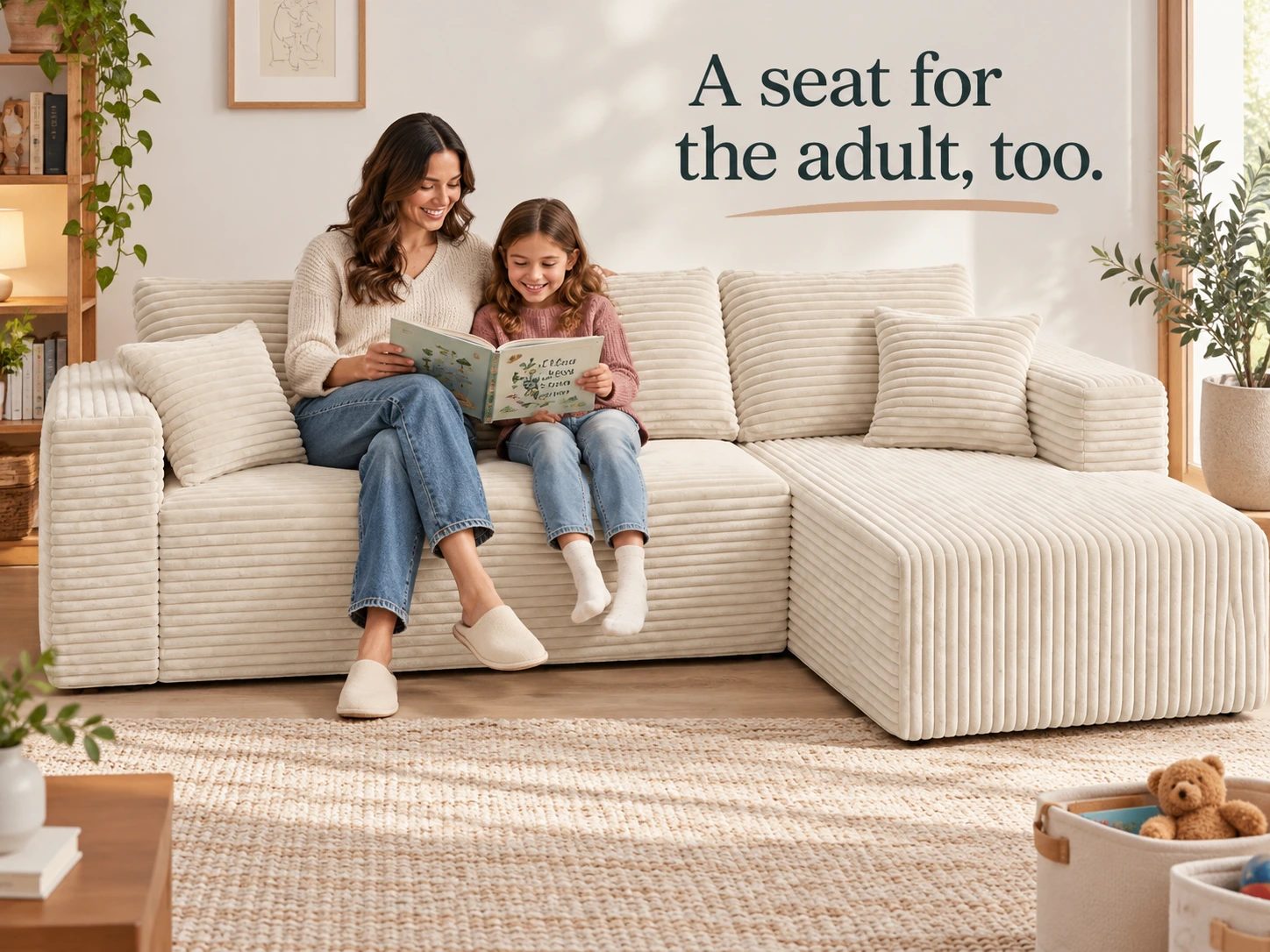
Think about standing up, too. If the adult frequently moves between the sofa and the floor, the low height will be part of every transition. A person who prefers a higher seat should make that comparison before choosing a low lounge design.
Count the people who use the room together. One adult and one child reading is a different arrangement from two adults watching children play. Keep enough usable positions for the routine you expect instead of counting loose pillows as extra seats.
Reserve the activity floor before adding more seating
THE L’s full footprint is 92.5 inches wide × 61 inches deep. The chaise accounts for the forward projection. Its small shipping carton does not reduce that footprint after unpacking.
Here is a worked example for a room that is 144 inches deep. Put THE L on one wall and a hypothetical 18-inch-deep storage unit on the opposite wall:
144 − 61 − 18 = 65 inches remaining between the chaise tip and storage.
That is the available strip before you pull out a bin, place a play mat or reserve a walking route. It is not 65 inches of guaranteed play space. All three uses must share the remaining area.
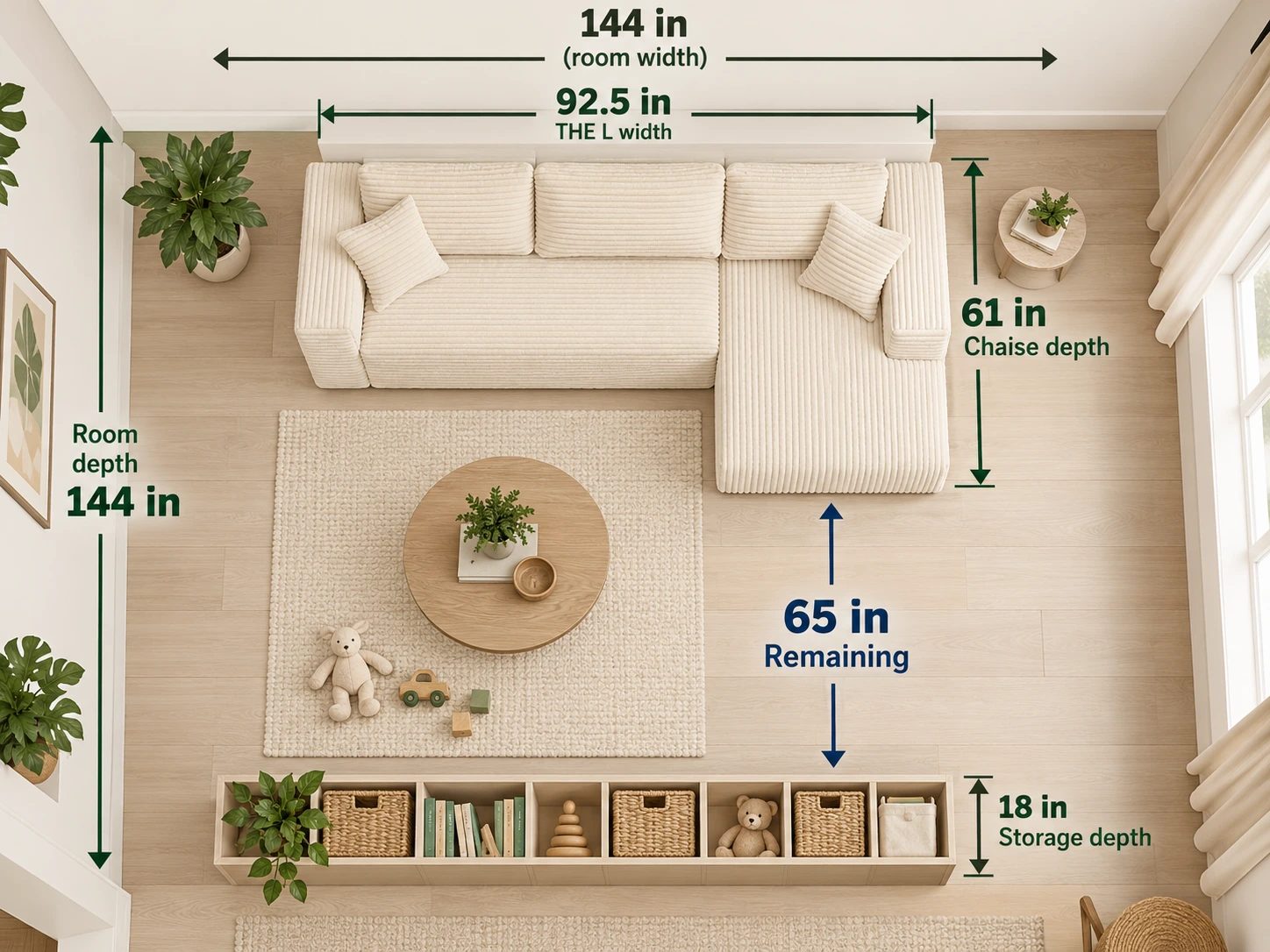
Lay out one real activity, such as a train track, floor puzzle or block-building area. Use its actual size rather than drawing a small symbol on the plan. Then have the seated adult stand and reach the storage while the activity stays in place.
If the room becomes awkward with the favorite activity open, reduce the furniture before asking the activity to shrink. A second ottoman or large coffee table may be less useful than a clear central floor. A small side table can hold the adult’s drink without occupying the main play area.
Repeat the test for cleanup. Can the activity go back into storage without someone standing on the sofa or moving a heavy table? A good room works when toys are out and when they are put away.
Choose the chaise side by where people gather
The chaise can make a comfortable reading or feet-up position. Its direction also decides which part of the floor remains open. Look at the selected product photograph and diagram, then draw that arrangement with the entry door and storage in place.
If the usual floor activity is directly beside the sofa, put the chaise where it does not separate the adult from that area. If the room has a busy entry corner, keep the projecting piece away from that approach. The aim is a seat that joins the room’s activity rather than creating a barrier across it.
Do not decide from a left/right label without seeing the arrangement. Compare both orientations against your own drawing. The relevant question is where the projecting chaise lands in this room, not which orientation sounds familiar.
| Family-room need | Layout to examine | What earns its place |
|---|---|---|
| Adult reading with a child and an open play floor | THE L: 92.5 × 61 in | One chaise with a clear activity area beside it |
| More regular seated users | Big U: 118.5 × 61 in | The additional center seat is used often enough to justify the width |
| A separate feet-up piece | THE U: 93 × 63 in | The ottoman has a useful parked position when floor play starts |
The wider sofa is not automatically the family-friendly choice. If it displaces the toy storage or closes the room’s approach, its extra seating can make the room harder to use. Choose the pieces with a regular job.
Test storage with the bins pulled out
A tidy photograph usually shows every storage bin pushed in. Daily use includes open drawers, a child choosing a toy and a bin left on the floor. Plan for that position as well.
Pull out the bin used most often. Place it where the child actually sorts its contents. Then check whether the adult can reach the sofa and whether another person can pass without stepping over it. If it blocks the only route, move the storage or choose a different bin position.
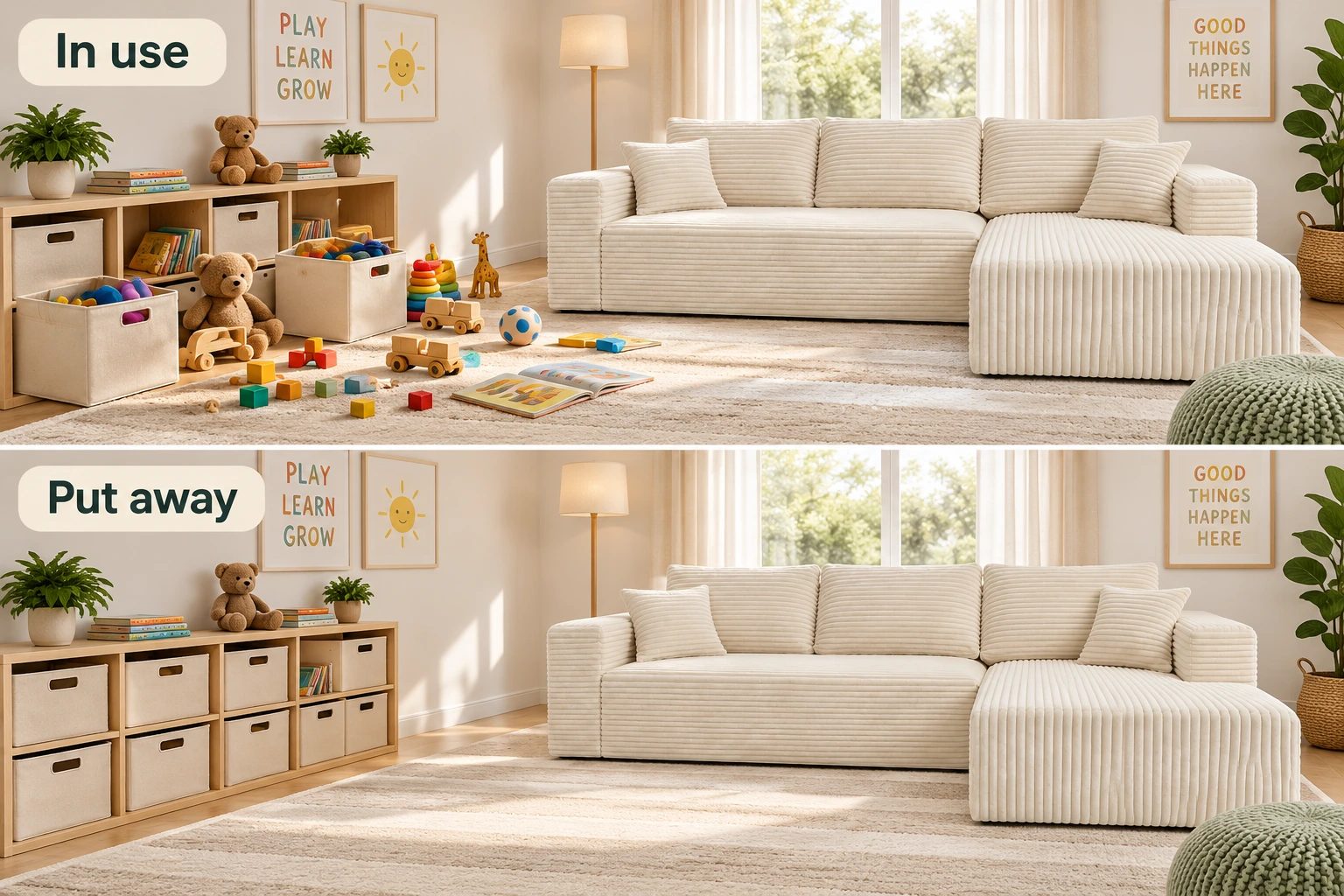
Put frequently used items where they can be reached without climbing. Keep the sofa arms and back from becoming the route to an upper shelf. Store adult supplies separately from children’s everyday materials so the room’s organization supports its actual users.
The seat needs its own reset routine. Return reading cushions to a consistent position and keep the main seat free of toy piles. A full-size sofa is less useful if an adult has to clear storage from it before every visit.
Make corduroy care part of the purchase
ULTIONE uses wide-wale corduroy: a plush surface with broad raised ribs. Those channels give the fabric its texture and also make it worth checking the areas where crumbs collect. Look along the seat seams, beside the arms and at the regular reading position.
For loose crumbs, use a clean upholstery attachment with gentle suction. Follow each panel’s rib direction rather than sweeping the entire sofa as though every panel runs the same way. Lift the tool at seams and avoid dragging a sharp edge across the pile.
For a fresh liquid spill, use a clean, dry white cloth to absorb it. Press gently, lift, and move to a dry fold. Scrubbing spreads the liquid and works it deeper into the channels. Remove loose solids separately before deciding on a permitted stain treatment.
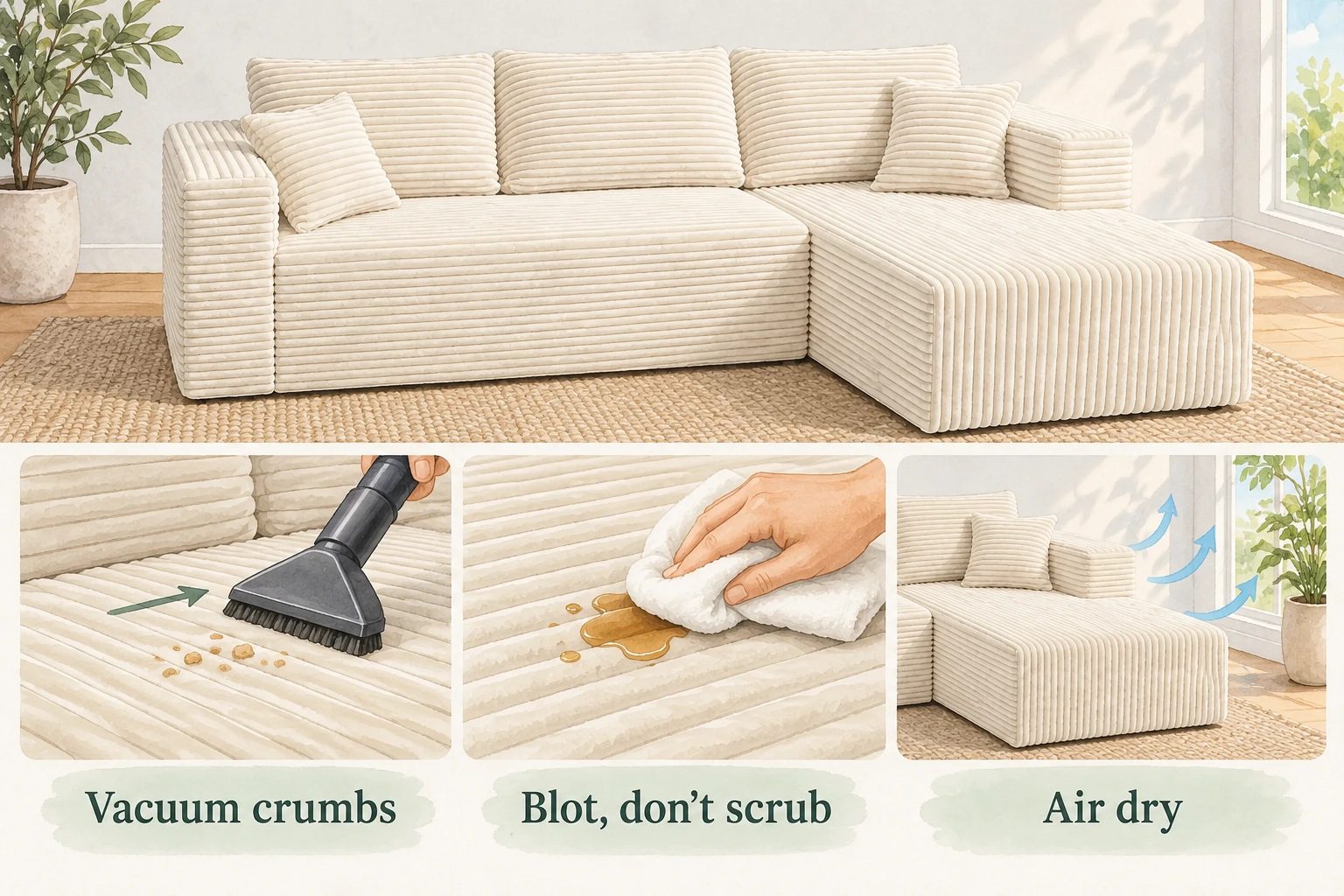
The covers unzip for care, as shown on the product page. Removability helps you access the cover; it does not by itself select a washing or drying method. Keep the care instructions with your purchase record, test a permitted cleaner in a hidden spot and use as little moisture as possible. Let a damp area dry fully with airflow rather than concentrated heat.
Build the room around that routine. Put a stable drink surface beside the adult seat, keep messy art materials in their own work area and give snack crumbs a quick dry cleanup. You do not need to turn the entire playroom into a no-food zone to avoid balancing a cup on upholstery.
Our corduroy-cleaning guide covers cleaning codes and different types of marks. The buying question here is simpler: are you comfortable maintaining a ribbed upholstered seat in the way this room will be used?
Check the furniture around the sofa
Room safety depends on the neighboring furniture and window coverings too. A low sofa does not remove the need to anchor a television or storage unit. The CPSC’s Anchor It guidance addresses TV and furniture tip-overs; use suitable anchoring hardware and the installation instructions for the furniture and wall involved.
Keep window cords away from the sofa and activity area. CPSC window-covering guidance recommends cordless coverings where young children are present and moving furniture and toys away from windows and covering cords. Health Canada provides corresponding guidance for Canadian households.
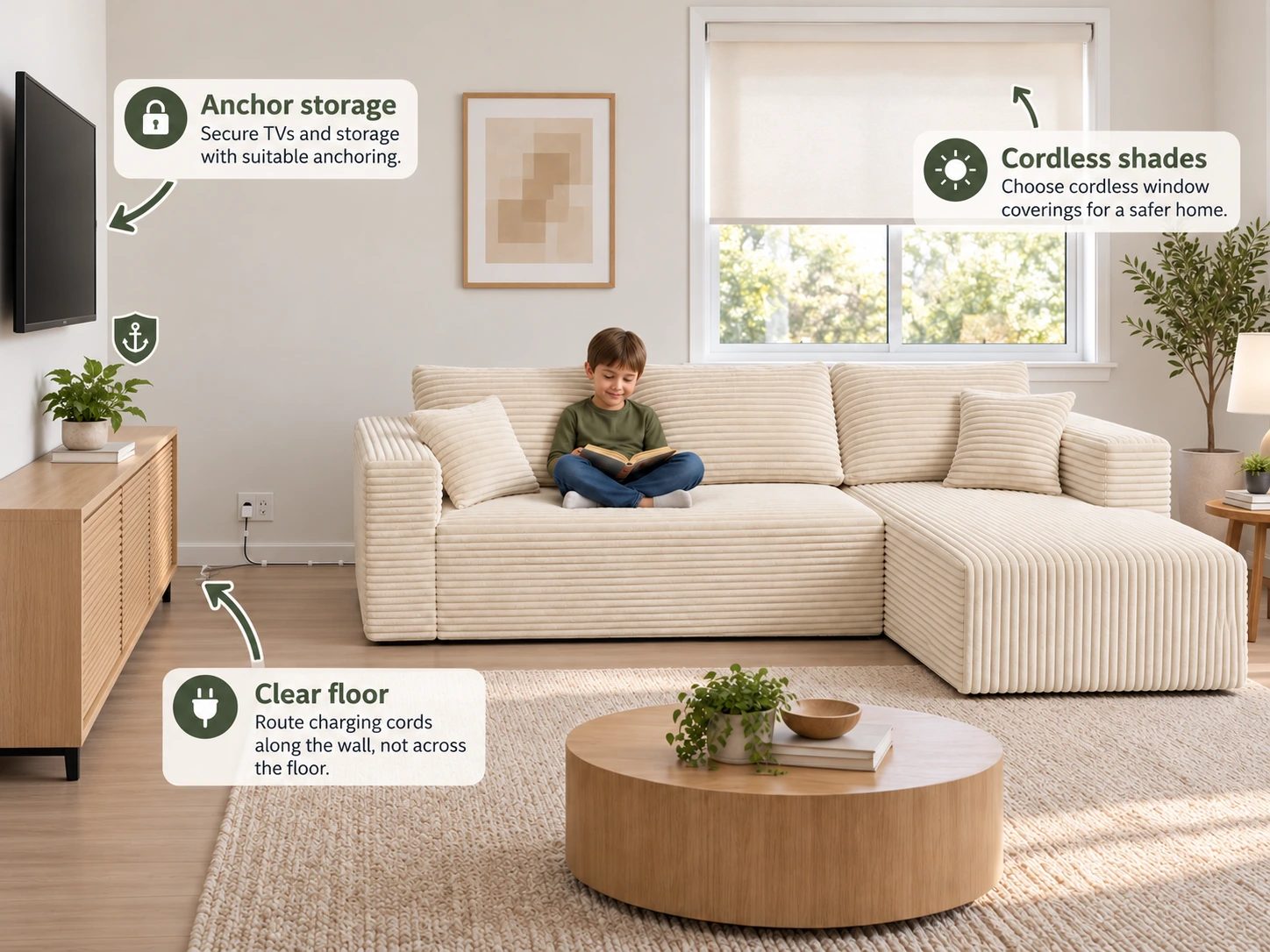
Keep charging leads against the room edge rather than across the play floor. Give lamps a stable position and check the room with curtains or blinds in their normal operating position. These are concrete placement decisions, not reasons to add more furniture.
Plan arrival and ordinary changes separately
Compressed delivery is useful if the playroom sits beyond a narrow entrance or upstairs. THE L ships in one 42.13 × 24.41 × 12-inch carton weighing 102.4 lb including packaging. Measure the complete delivery route and arrange suitable handling help. No frame assembly is needed once the sections reach the room.
Open the package in the intended setup area, remove the wrapping and position the modules. Keep packaging and loose materials away from children while setting up. Reserve the room until the sections are placed and the unpacking materials are cleared.
For later layout changes, use the expanded module dimensions. The original compact shipping form is not the shape you should assume for an ordinary move. Keep the carton figures for arrival and the expanded footprint for daily room planning; they answer different questions.
Choose the seat that makes family time easier
Consider THE L when you want full-size compressed seating, a low lounge position and one chaise alongside an open activity floor. Its wide-wale corduroy and unzip covers have a practical care routine, while its 92.5 × 61-inch footprint gives you specific numbers to check before ordering.
Consider Big U when the extra center seat will be used regularly and the room can accept its 118.5-inch width. Keep the smaller layout if that width would remove the floor space your household uses most.
Before choosing, try the adult reading position, lay out a real floor activity and pull out the busiest storage bin. If all three work together, you have a room that supports the family—not just a sofa that fits an empty rectangle.